

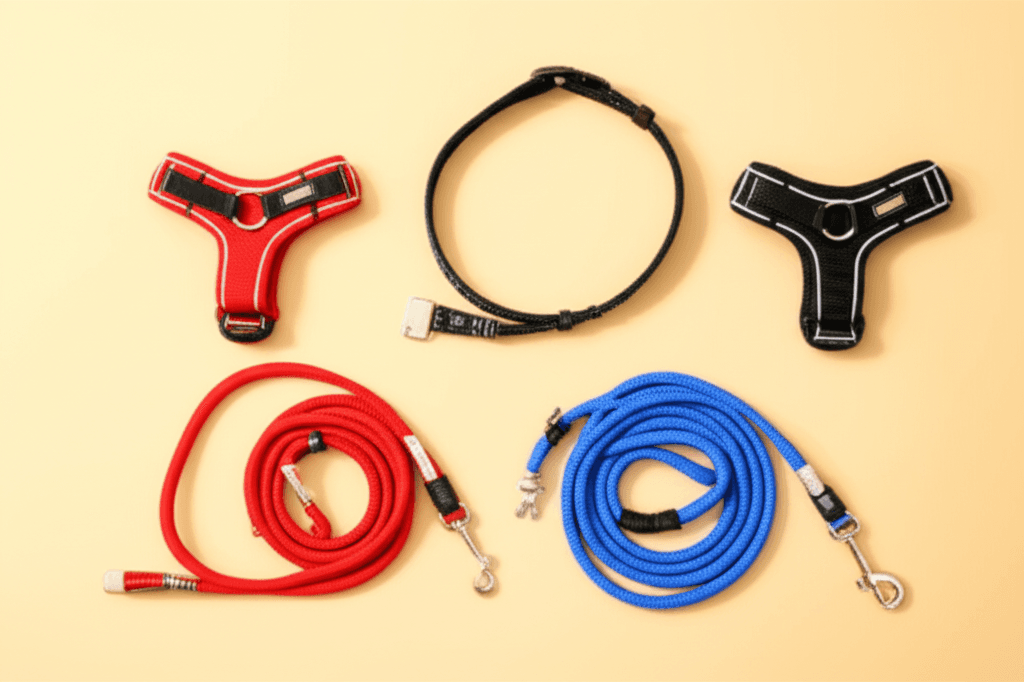
Start with your real-life walks (not the product shelf)
The best way to pick gear is to picture your actual day: the dash out the door when your dog is already doing zoomies, the tight sidewalk past tempting smells, the rainy walk where everything gets soggy, or the calm evening loop where your dog strolls like a little philosopher. A good collar and lead should make those moments easier and safer, not add friction. That’s why a solid dog collar guide starts with your dog’s shape, habits, and comfort—not just what looks cute.
Before you even compare styles, get two things right: fit and attachment points. For collars, you want a snug-but-comfy fit—tight enough that it won’t slip over the head, loose enough that it doesn’t press or rub. Most people use the “two-finger” check, but the real test is practical: can you rotate the collar a bit without it sliding freely? For leads, think about where the clip will sit and how it will move as your dog turns, stops, and sniffs. A clip that constantly twists can create little tangles that turn into big annoyances.
Also, be honest about pulling. Lots of dogs pull sometimes. That doesn’t make you a “bad trainer,” it just means your gear choice matters. If your dog regularly hits the end of the lead like they’re testing a bungee cord, you’ll want equipment that spreads pressure and gives you better steering—this is where the harness vs collar question becomes more than a debate and starts being a comfort-and-control decision.
Collars: what they’re best at (and what they’re not)
A collar is great for everyday ID and quick transitions—clip on, head out, done. For many dogs, a well-fitted flat collar is the simplest, most comfortable option for calm walks and daily wear. Look for smooth edges, sturdy stitching, and a buckle or clasp that feels secure but not fiddly. If your dog has sensitive skin or a very short coat, pay attention to the inner material; rough webbing can cause rubbing in the same spot, especially in hot weather when your dog is more likely to get damp around the neck.
Martingale-style collars are popular for dogs whose heads are narrower than their necks (think sighthound shapes) or for dogs who have a talent for backing out of a standard collar. They tighten within a limited range, which can help prevent slipping without relying on a fully tightening design. The key is fit: it should tighten just enough to prevent escape, not keep tightening. If you’re unsure, ask a trained professional in-store or your trainer to show you how it should sit when tension is applied.
Now, the part people don’t love hearing in a dog collar guide: collars aren’t ideal for strong pullers or dogs who cough, gag, or get “throaty” when they’re excited. If your dog tends to surge forward, the pressure can concentrate on the neck. That’s one of the biggest reasons owners switch to a harness for walking, while still keeping a collar on for ID.
A quick practical tip: if you plan to keep a collar on most of the day, check under it regularly. Dirt and fine sand can hide under collars and act like sandpaper over time. If your dog swims or gets wet often, rotating between two collars can help—one can dry fully while the other is in use.
Harness vs collar: the decision that changes the whole walk
Let’s make harness vs collar simple: if your dog walks politely and doesn’t strain, a collar can be enough for attaching a lead. If your dog pulls, startles easily, is still learning leash manners, or has a delicate neck area, a harness often makes walks more comfortable and gives you better control.
Not all harnesses feel the same to a dog. A good everyday harness should sit clear of the soft throat area, allow full shoulder movement, and have straps that don’t dig into the armpits. That armpit rub is the number-one complaint I hear from owners who “tried a harness and hated it.” Usually it’s not the idea of a harness—it’s the wrong shape or size. Watch your dog walk a few steps: if the harness shifts a lot side-to-side, rides up toward the neck, or the front straps sit right in the armpit crease, try a different size or style.
Front-clip harnesses can be especially helpful for dogs who pull because they gently redirect the chest when the dog surges forward, making pulling less effective. Back-clip harnesses are often comfortable for steady walkers and can feel less “busy” for dogs who don’t need steering help. If your dog is an escape artist, look for a harness with multiple adjustment points and a secure fit around both the chest and the body—some dogs can back out of loose harnesses with impressive speed.
One more real-world detail: if you’re juggling a coffee, a phone, and a dog who changes direction every two seconds, a harness can give you a little buffer. It’s not a training plan, but it can make training possible because you’re not bracing against neck pressure every time your dog spots a squirrel.
Lead types: matching the lead to the moment
There are plenty of lead types, and the “best” one depends on what you’re doing. For most daily walks, a standard fixed-length lead is the easiest to handle and the least likely to tangle. It gives your dog enough room to sniff without giving them so much distance that you lose communication. If you’ve ever tried to shorten a long lead in a hurry while your dog is circling a lamp post, you already know why simple can be smart.
A shorter lead can be a lifesaver in busy areas or when you’re working on polite walking past distractions. It keeps your dog close without you having to wrap loops around your hand (which can be uncomfortable and, in some situations, unsafe). On the flip side, longer training leads are useful for recall practice and decompression sniffing in open spaces—just be ready to manage the extra line so it doesn’t snake around legs.
Hands-free leads are brilliant for people who want to walk and keep their hands available—great if you’re carrying shopping, pushing a stroller, or just prefer a more relaxed posture. The key is pairing them with a dog who won’t suddenly launch forward; if your dog is still learning, you might use hands-free gear in calmer environments first. For dogs who pull, you’ll want to focus on a comfortable waist belt and a bungee section that softens sudden jolts (without turning your walk into a tug-of-war).
Retractable leads are tempting because they offer distance, but they’re not the best fit for every situation. They can make it harder to communicate consistent boundaries, and the thin line can be difficult to see. If you do use one, it’s usually better in open areas where you’re not navigating crowds, tight paths, or lots of obstacles.
Material matters more than people think. Webbing leads are durable and easy to clean. Rope leads tend to feel nice in the hand and can be a good choice if you want something that won’t burn your palm during a sudden pull. Leather can be comfortable and long-lasting when cared for, but it does ask a bit more of you—keeping it dry and conditioned so it stays supple.
The small details that make a big difference
Hardware is one of those “boring” features that becomes exciting the first time a clip fails. Look for solid metal clips that open smoothly and close with a confident snap. If your dog is large or strong, consider heavier-duty hardware and a thicker lead that won’t bite into your hand. For smaller dogs, lighter hardware can be more comfortable—big clips can bounce and feel awkward.
Think about your own comfort, too. A padded handle can make daily walking easier, especially if your dog pulls occasionally. If you’re often out in low light, reflective stitching or a bright color can help you stay visible. And if your dog is the type to splash into every puddle, quick-drying materials will save you from that “damp lead” smell that seems to live forever.
If you’re shopping as a set, it’s perfectly normal to mix and match: a collar for ID, a harness for walking, and a lead that suits your routine. That combination solves the most common frustrations I see—dogs uncomfortable on neck pressure, owners struggling with control, and gear that looks great but doesn’t hold up to daily life.
When in doubt, try this simple approach: choose the collar that your dog can comfortably wear for hours, pick the walking attachment (often the harness) that makes your dog’s movement look easy and natural, and select from lead types based on where you walk most often. If you keep that trio in mind, the harness vs collar decision gets clearer, and your dog collar guide checklist stops feeling like a puzzle and starts feeling like common sense.