
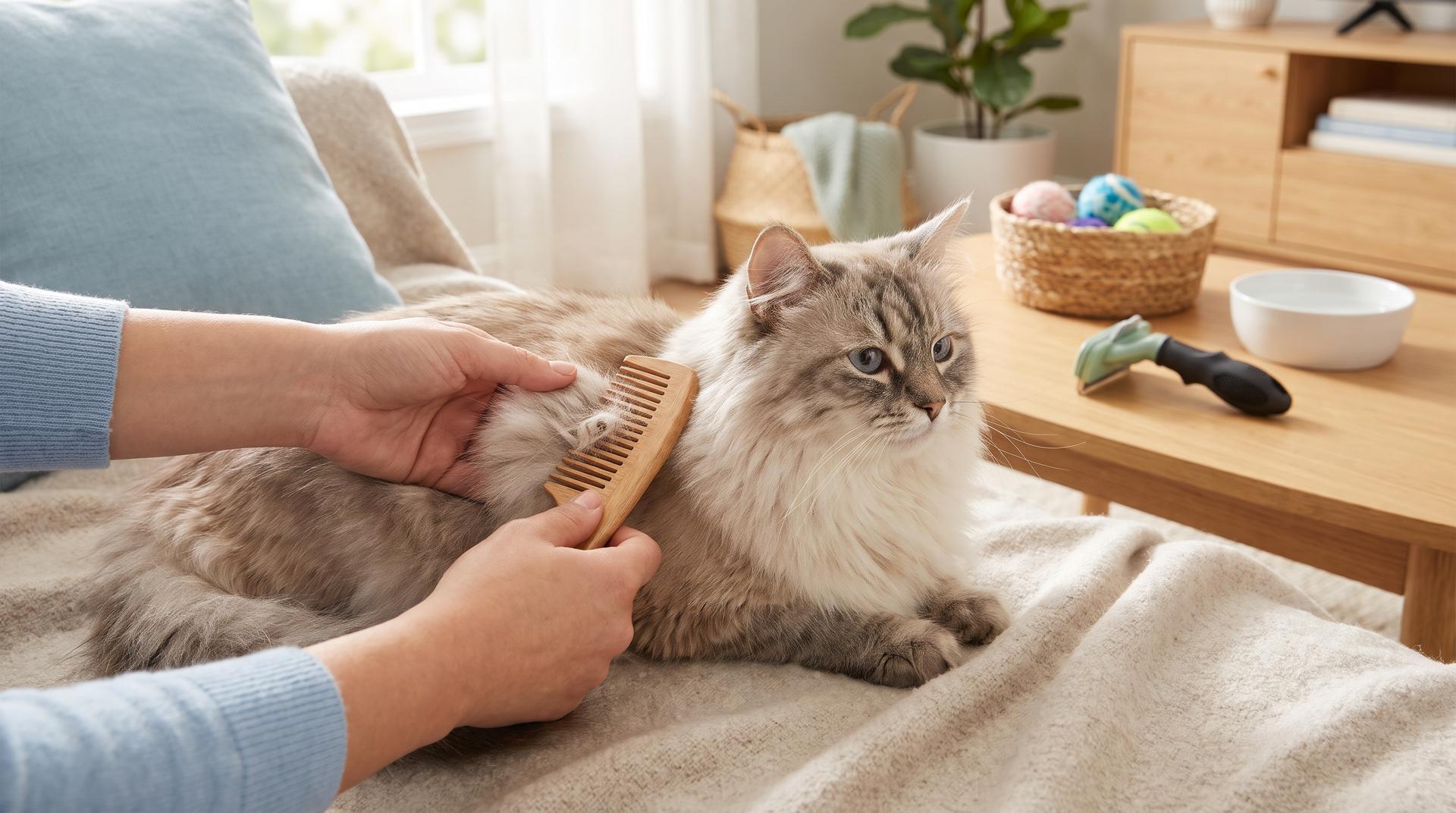
Your cat’s back looks beautifully smooth, and the brush glides over it without a hitch. Then you stroke behind an ear and discover a knot you never noticed. That is the tricky part of long-haired cat grooming: a tidy-looking surface does not tell you what is happening underneath. The useful skill is not brushing harder or longer, but learning to check beneath the fluff, recognise what you can gently loosen, and leave anything more difficult to experienced hands.
Look beneath the smooth topcoat
Set up somewhere quiet, on a stable surface where your cat can stand or sit without slipping. For long-haired cat grooming, a rounded-tooth metal comb with a widely spaced section is useful alongside a brush your cat already accepts. Keep a small reward nearby and choose a moment when your cat is relaxed but awake. If the comb itself is unfamiliar, let your cat investigate it before attempting a coat check; this does not have to become a full grooming session.
Start on an easy-to-reach area, such as the shoulder or side, and use your fingertips to separate the coat into small sections. Look towards the roots rather than judging the shiny outer hairs alone. To find hidden cat coat tangles, feel for places where the hair stops moving freely and instead gathers into a snag, lump, or flattened patch. If you cannot comfortably separate an area with your fingers, do not push a comb underneath it to investigate.
Pay particular attention behind the ears, beneath the collar or harness, around the armpits, and along the backs of the hind legs. These spots can be easy to miss during a quick sweep over the back. Check the belly only if your cat willingly allows access; rolling a reluctant cat over or holding a leg out creates a struggle before you have even started. An inaccessible patch is a reason to seek help, not a reason to restrain more firmly.
Separate a loose snag from a mat
A small, loose snag has individual hairs you can still separate gently with your fingertips. A mat feels more like a compact pad or felted lump, and you may not be able to see where it ends and the skin begins. Size alone is not a reliable guide: even a tiny knot can sit tightly against the body. At home, stick to loose tangles that separate easily without pulling the surrounding coat or moving the skin.
For one of those loose snags, support the small section of hair between the tangle and the body without tugging it upwards. Gently ease the outer hairs apart with your fingers, then try the wide-spaced comb teeth at the free ends. Use short movements, gradually working closer to the roots only as each part becomes easy to comb. The goal of gentle cat brushing is a tool that travels through freely, not a knot that eventually gives way under pressure. If the comb catches, stop that stroke rather than pulling through.
Once the section is clear, make a light checking pass through the hair you have separated, following its direction of growth. There is no need to scrape the skin or repeatedly brush an already clear patch. A brush may smooth over a snag that a comb detects, so do not treat a glossy finish as proof that every layer is clear. If you find yourself returning to the same resistant knot, you have reached the limit of that attempt.
Let resistance and body language set the limit
Watch your cat as closely as you watch the coat. A flicking tail, rippling back, ears turning sideways, sudden head turns towards your hand, or repeated attempts to leave are cues to pause. Stop before those signals become swatting, biting, or a determined escape. A cat who goes very still is not necessarily comfortable either, particularly if their body has become tense. Put the tools down and let your cat move away rather than trying to squeeze in one last stroke.
The coat itself can give you an equally clear stopping point. Leave a tangle alone if it is tight against the skin, forms a dense patch, pulls the skin when touched, or cannot be loosened easily with your fingers. Contact a groomer experienced with cats and explain where the mat is and how your cat responds to handling. If you notice broken skin, redness, moisture, an unusual smell, or discomfort with ordinary touch, contact your veterinarian before continuing.
Do not cut out a mat with household scissors, even if you plan to slide a comb between the knot and the skin. Hidden folds of skin make that boundary difficult to judge. Mat-splitting blades and home clipping are not good substitutes for a knot that has already defeated gentle handling; leave close removal to an experienced professional. Skip bathing as a way to solve the problem, too, and ask the groomer how to prepare rather than wetting a tangled coat or applying household oils.
Make the next check smaller and easier
The most useful long-haired cat grooming routine is one your cat will comfortably participate in. Try a brief daily check of a few accessible spots, adjusting brushing frequency to how readily the coat tangles and what your cat tolerates. You might check behind the ears today, then the collar area and hindquarters at the next opportunity. Keep track of what you have checked so that easy areas do not get all the attention while awkward ones are repeatedly missed.
Notice patterns rather than simply adding more brushing. If knots keep appearing beneath a harness, remove it when it is not needed and check the coat after use. If your brush leaves the topcoat sleek but you repeatedly find snags underneath, ask a cat groomer to demonstrate sectioning and tool choice on your cat’s particular coat. Bring a description of the trouble spots and explain which handling your cat accepts; that information is more useful than arriving after another prolonged attempt.
Finish an easy session with something your cat enjoys, whether that is a small treat, a favourite toy, or simply being left to settle nearby. You do not need to complete the whole coat for the session to count. Good long-haired cat grooming means noticing what is hidden without turning every discovery into a battle. A smooth back is lovely, but a comfortable cat and a clear plan for that stubborn knot matter more.